
Conflict of Laws

Why So Much on Conflict of Laws?

Cart Before HorseVLDA has not even published a single substantive law, why is it so busy developing conflict of law rules?  Isn’t that putting the cart before the horse? Fair questions.  But one cannot understand voluntary law, if one does not understand the importance of plausible universal conflict of law principles to the basic premise of voluntary law.

Voluntary law is based on the premise that no law is legitimate unless previously voluntarily adopted by the person on whom it is enforced.  Because people by nature hold different moral preferences, often very deeply so, alternative laws and groups of people holding to different voluntary laws (i.e., different voluntary law societies) that are not separated from one another by territorial boundaries must coexist.  The accident of one’s location cannot be a controlling factor in determining the law to be applied.

In this environment, conflicts between people belonging to different voluntary law societies are inevitable.  Since there is no universal substantive law, there needs to be default conflict of law rules (also called “universal” rules) for selecting the law to be applied to inter-society conflicts, in the absence of any prior agreement on the matter.

The need for default conflict of law rules does not preclude members of different voluntary law societies from adopting a common set of conflict of law rules different from the default set.  Where all parties to a dispute have previously adopted the same conflict of law rules, there is no need to use the default set.  The need for a default set exists because there is no way to guarantee that all parties to a dispute will agree to use the same conflict of law rules.  In such cases, the default set provides the only option for resolving the dispute without forsaking voluntary law entirely.  The default set of conflict of law rules therefore needs to be neutral and sound enough to gain widespread if not universal acceptance as the rule of last resort for any person who would live according to voluntary law.

Variations in the default set can be tolerated without too badly undermining voluntary law systems, to the extent such variations are confined to boundaries that are discernible and not easily disregarded.  For example, dispute resolution services located on the Moon might apply different conflict of law rules than similar services on Earth.  Such differences could exist without injecting an intolerable amount of uncertainty into inter-personal relations, so long as constraints on travel between the Moon and Earth (a) make it easy for Moon people to avoid contact with Earth people, and vice-versa, and (b) make the probable forum for resolving disputes between Moon people and Earth people, in any particular circumstance, fairly predictable.  Without a substantial degree of separation between adjudication forums that apply different default conflict of law rules, the practical effect of adopting a particular set of laws may become much less predictable, undermining incentives for adopting voluntary laws.

In the absence of default or previously agreed-to conflict of law rules, the options for resolving conflicts in which the parties cannot agree on the law to be applied are limited to extra-legal remedies or appeal to a non-voluntaryist authority.  Either of these options breaks the system, rendering voluntary law ineffective and inferior in this respect to authoritarian legal systems.

More fundamentally, a house divided against itself cannot stand.  Without generally accepted conflict of law principles, the pluralistic nature of voluntary law will lead to division.  Difficult disagreements will arise over which laws to apply in disputes between members of different voluntary law societies.  These differences may become every bit as bitter and divisive as political fights over moral preferences in statist institutions.

So it’s important to conceptualize practical and morally compelling conflict of law rules as a foundational issue.  Once the foundation has been laid, the focus will shift to building the matrix of voluntary law that will stand on the foundation, which consists of the core principles and the universal conflict of law rules already developed or now under development.

The VLDA does not want to invest in a system of voluntary laws that is vulnerable to divisive politics, or that is notably inferior to authoritarian systems in any respect.   Therefore it seeks to demonstrate, at the outset, that a system of voluntary laws can make use of a universal system of conflict of laws, without being exploited by evil doers or accidentally producing results that incentivize evil behaviors.  The goal is to satisfy reasonable expectations in disputes between people holding different moral preferences and different laws, based on the fundamental principle of reciprocity.  Results may be different from, and hopefully better than,  results from authoritarian legal systems.  All differences are illuminating.

The most difficult issues in universal conflict of laws for voluntary law societies have been discussed in sufficient detail to create confidence in the plausibility of VLDA’s mission.  There are only a few loose ends to wrap up, and then it will be on to the next job of constructing the matrix of laws.  Meanwhile, new and surprising things about voluntary law are being learned all along the way.

Standard
Conflict of Laws, Version Updates

Jurisdiction and Update to Conflict of Laws

Jonny has again updated the universal conflict of law rules.  The rules have been simplified, and hopefully improved.

First,the rules are updated to include the “No Hypocrisy” rule discussed in the immediately preceding posts.  This was done by adding a new last sentence to paragraph 3(a).  Please see the preceding posts for further discussion of the No Hypocrisy rule.

Second, all rules dealing with selection of law in cases where either of the defendant or plaintiff has not adopted a voluntary law are removed.  Such provisions are unnecessary, because the existence of a claim requires that the plaintiff has adopted a voluntary law.  Also, for the defendant, voluntary jurisdiction over the person requires that the defendant has either adopted a law prior to the claim arising, or will do so afterwards because she prefers to resolve the claim in a voluntary forum.  So it will always be possible to determine the laws that have been voluntarily adopted by plaintiff and defendant.  This is in essence a jurisdictional aspect of voluntary law.

Adoption by Choice, Erie PA

Adoption by Choice, Erie PA (Photo credit: hbimedialibrary)

Jurisdiction over a person in voluntary law is always voluntary.  It arises by the person adopting a voluntary law sometime prior to the adjudication of the claim.  After having agreed to appear, if the person has not already adopted a law pertinent to the case, she will certainly do so prior to the adjudication to influence the outcome of the process as much as possible.

Late (post-claim) adoptions of voluntary law may occur frequently in transitional societies including both voluntary law society members and non-members, when a member decides to bring a claim against a non-member.  To avoid being sued in a statist court, the defendant may join a voluntary law society by publicly adopting a published voluntary law.  At that point, the plaintiff must either proceed in the voluntary law forum and forsake any state-imposed remedy, or sacrifice his reputation as a voluntary law society member and become subject to liability under voluntary law for unnecessarily resorting to a statist court.

This jurisdictional rule allowing late adoption of voluntary law facilitates expansion of voluntary law societies.  Once dispute resolution services of competitive quality become available, non-adopters of voluntary laws will naturally be drawn into voluntary law society membership to take advantage of the unique and beneficial qualities of voluntary law for defendants, like the ability to control which law is applied in a dispute resolution and lower process costs due to free competition in dispute resolution services.

Some short-sighted persons may craftily adopt and renounce voluntary law for opportunistic reasons.   Such persons may sometimes escape liability under voluntary law, but will quickly destroy their reputations and currency in voluntary law societies.  They will be few and transitory.

Standard
Conflict of Laws

The No-Hypocrisy Rule

It is self evident that equal treatment under the law requires an absence of hypocrisy.  Equal treatment requires that each are judged under the same measure as each would judge others.  That whatsoever a person metes out, is meted back.

Cain and Abel. Byzantine mosaic i =n Monreale

Cain and Abel. Byzantine mosaic i =n Monreale (Photo credit: Wikipedia)

Under an authoritarian system, the same law can be imposed on all, and the fiction of equal application promoted.  This is a logical solution, although horribly idealistic and impractical.    Those in power are never subject to the same laws they impose on others, either openly by holding an elite status, or secretly by  corruption.  In a system of voluntary law societies, such fictional solutions are unnecessary and impossible.

Instead, we have the dilemma of choosing the law to apply in a dispute between persons who hold to conflicting laws.  Under the basic principle of voluntaryism, we must generally apply the defendant’s law.  To disincentivize opportunistic adoption of law by persons set on evil deeds, this rule can be tweaked to impose the most severe law — the “law of greatest liability” — adopted by the defendant at any time since just before the legal complaint at issue first arose.  So far so good, but some unfairness is evident under this rule, in that persons adopting more severe laws are vulnerable to being sued by those who have made themselves invulnerable, or less vulnerable, by adopting less severe laws.  Such a system might create too much pressure for all to adopt laws of minimal or no liability, and thereby undermine the usefulness of the law for proscribing appropriate remedies for wrongs, and providing incentives for legal settlement instead of extra-legal direct retribution.

To avoid this outcome, plaintiffs should be barred from enforcing any law of greater liability than the plaintiff has himself adopted.  This is the “No-Hypocrisy” rule mentioned in the previous post.  In other words, if (and only if) the defendant’s “law of greatest liability” results in greater liability than the plaintiff’s “law of least liability,” then the dispute must be decided under the plaintiff’s “law of least liability.”

Generally speaking, applying the Defendant’s  Law and No-Hypocrisy rules together is almost logically equivalent to simply applying the law of least liability between plaintiff and defendant in any given circumstance, but not exactly so.  For if the plaintiff’s “law of least liability” results in greater liability than the defendant’s “law of greatest liability,” then the defendant is held to the law of greatest liability adopted by defendant during the relevant time period, which may result in greater liability than some less severe law adopted by defendant during the relevant time.  Nonetheless, except for the foregoing circumstance, it will usually be the case that the least severe law held by plaintiff or defendant during the relevant time period will be the law applied.  Thus, all parties have an incentive to adopt sufficiently severe laws to afford themselves reasonable remedies, and to provide an incentive for those they have wronged to seek legal remedies instead of extra-legal remedies.

For example, if Cain adopts a law in which there is little or no penalty for murder, and then murders Abel (who, like all of his family, has adopted a law with severe penalties for murder) then Abel’s family can legally find no justice or satisfaction under Cain’s law.  They may, however, extra-legally murder Cain in retribution, without putting themselves at any greater risk of legal liability than Cain.  Anyone bringing a legal action on behalf of the slain Cain would be limited to the “law of least liability” adopted by Cain during the relevant period, which is the time from just before Cain murdered Abel until Cain was himself murdered by Abel’s avengers.  It’s quite easy to see why Cain could not rationally expect that adopting an overly lenient law would be of any personal benefit in securing his own safety and happiness.

Such would be true, unless by some extraordinary means Cain is immune from being murdered.  Acquiring such immunity for a public adopter of a law permitting murder without punishment, such as Cain, may be presumed impossible without the intervention of a state, at least for the moment.  The topic — here called the “Impossibility Problem” of the “Reciprocity Principle” — has already been touched upon and deserves further consideration.  At least in a universe of mortal persons, the Impossibility Problem arises in the context of property claims but not, in any practical sense, in the context of claims for bodily or personal harms.

It bears repeating, although it is not the main point of this post, that application of the Defendant’s  Law and No-Hypocrisy rules for resolving conflicts of law among voluntary law societies will generally have an leveling effect in the area of property rights, due to pressure from the Impossibility Problem.  Voluntary law may be expected to push property rights to the very minimum of what the vast majority of people deem acceptable.  And that minimum will tend to lie at the maximum of what the vast majority of people can realistically hope to own.

Thus, unlike capitalist society as practiced in the 19th century, it will be impossible under voluntary law for durable classes divided between property owners and non-owners to arise.  Whenever great inequities arise, those who lack any realistic hope of acquiring a specific class of property will adjust by adopting laws that do not recognize the elitist property claims of others.  Under the defendant’s rule, the elitist property claims will thereby be rendered practically unenforceable.

None of this requires insurance companies or quasi-governmental dispute resolution organizations to make or enforce laws on a less well-capitalized general public.  Instead, under voluntary law, the general public imposes its preferences in laws and legal claims on anyone who would provide legal, enforcement, or insurance services.  The legal preferences of the people  are what determine the environment in which legal service providers, insurers, and police must operate.  Voluntary law truly returns the power to determine laws to the general public, and frustrates at every turn rule by elites.

Standard
Conflict of Laws

How Voluntary Law Beats Marxism/Leninism

The title of this post is thinking ahead and overreaching, of course.  But it is not entirely without reason.

It is postulated in the preceding post that the reciprocity principlereciprocity8 might create social pressure for property laws of minimal reach.  It is too early to firmly draw this conclusion, but the thought deserves more explanation than earlier provided.

If conflict of law principles prefer application of the defendant’s law, this enables persons who themselves lack a class of property and any reasonable prospect of obtaining it to adopt laws that do not recognize the class of property at issue.  For example, suppose writers adopt copyright laws while consumers adopt copy-freely laws.  Under the conflict rule of defendant’s law, a writer could be sued for copyright infringement by a consumer, but a consumer could not be sued for copyright infringement by a writer.  To avoid this injustice, writers would choose copy-freely laws and find some other way to earn money from their craft, other than demanding post-publication royalties.  Therefore, the social pressure exerted by a large class of consumers adopting copy-freely laws (and thereby giving up the possibility of receiving royalties) would tend to cause writers to do the same, albeit reluctantly.

It does not take too much thought to understand that the same result would apply to every class of property rights in a system of voluntary law societies that applies the defendant’s preference in choice of law, wherever there exists a large class of people with little hope of obtaining and exercising the class of rights at issue.  Therefore, the property rights that would tend to evolve and be maintained would be those that are universally enjoyed and hoped for.  It would be impossible for a class of entitled persons to hold peculiar property rights, either in kind or in degree, and thereby extract rent from less privileged classes, as occurs in statist societies.  It would be impossible to enforce elitist property rights against a much larger class having no hope of enjoying the same, because the less privileged class would simply adopt laws that do not recognize the property right at issue, thus creating pressure for the elite class to do the same.

This leveling pressure could be mitigated by tweaking conflict of law rules, for example by refusing to enforce a claim based on defendant’s law, whenever the plaintiff’s law would result in a lesser penalty than defendant’s law.  This might be called the no-hypocrisy rule in choice of law.  The no-hypocrisy  rule may provide a desirable amount of friction against the leveling pressure exerted by the rule of defendant’s preference in slighter cases of imbalance, without stopping the pressure in more extreme cases.  The writer believes, but cannot currently prove, that eliminating the defendant’s rule entirely would break the fundamental principle of voluntary law selection.  Perhaps systems such as averaging or random selection could also be regarded as voluntary in nature; generally applying plaintiff’s law probably must be regarded as breaking the voluntary nature of the system.  All of this needs further development.

Yet we are beginning to see a truly marvelous and unexpected result of starting with the basic principles of voluntary law: a solution to the problem of entrenched property classes that so befuddled Marx and his followers, and led to so much death, destruction, and wasted lives in the 20th century.  Voluntary Law holds the promise of making the holding of elite property interests impossible through the simple, peaceful, and statelessly democratic process of recognizing no law but that which is voluntarily adopted, and generally applying defendant’s rule to conflicts of laws.

This is a very bold claim to make, and may perhaps be disproved.  If you think the claim is wrong, please do try and show why.

Standard
Conflict of Laws, Reciprocity

The Reciprocity Principle and The Impossibility Problem

Personal Property (film)

Personal Property (film) (Photo credit: Wikipedia)

Resolving conflicts between different laws can be handled by the reciprocity principle.  Reciprocity means that a party is judged by the same law by which that party would judge others.  Therefore, in the context of voluntary law, this means that the defendant’s choice of law has priority, in the event of a conflict of laws.

Defendant’s “choice” cannot be based on an opportunistic selection made with a particular claim in mind.  Instead, the choice is determined by which law or laws the defendant has adopted at any time since just before the earliest event giving rise to the claim, or since some other earlier time.   If the defendant has adopted different laws during the applicable period, the applicable law can be the one that would result in the greatest liability for the defendant.  This rule of “defendant’s law of greatest liability” disincentivizes opportunistic adoption of lenient laws to escape liability for planned evil deeds.

The reciprocity principle and greatest liability rules work at least reasonably well for claims based on personal harms such as murder, battery, rape, kidnapping, etc., for the simple reason that every person has a body and therefore faces the same or similar risks of suffering personal harms.

One can hypothesize that the reciprocity principle would not work well for relations between mortal and immortal persons, because of the imbalance of risks.  For example, an immortal person might prefer a law that permits murder freely without penalty, because the immortal person cannot be murdered.   The immortal therefore might prefer that there be no penalty for murder to reduce the risk of facing claims of murder from others, without in any way increasing her own risk of being murdered or need to recover damages for her own untimely death.  This problem might be called the “impossibility problem” because it is impossible for a class of persons to suffer the same harms as another class of persons, so reciprocity becomes impossible.

While the existence of immortal persons is merely hypothetical, the impossibility problem is a present reality for claims based solely in property rights, for the simple reason that not everybody holds the same types of property.  While virtually everybody has personal property of some kind, some may own no real property (e.g., land), or no “intellectual property.”  Consider, for example, the case of copyright.  Creators of books and so forth might generally prefer the ability to make claims against those who copy their works without permission.  Mere consumers of books, on the other hand, might generally favor no such penalties.  Under the principle of reciprocity, there is no way for a content creator to bring a copyright claim against a mere consumer who has not adopted any law recognizing copyrights as a class of property or claims.  Whether you consider that outcome good or bad, it provides an example of the impossibility problem at work.

One can imagine similar problems in real property.  For example, suppose one person (Lysander) adopts a law that adverse possession requires open and unchallenged use for a continuous period of three years.  Another person (Murray) adopts a law requiring only one year of open and unchallenged use.  Murray openly squats unchallenged on Lysander’s land for 2 years, at which time Lysander sues to evict Murray.  Murray countersues to claim Lysander’s title.  Applying defendant’s rule to Lysander’s claim, Murray wins.  Applying defendant’s rule to Murray’s claim, Lysander wins.  Therefore, Lysander cannot legally evict Murray, nor can Murray obtain Lysander’s title.   The practical result may be that Murray can stay rent-free for as long as he pleases, but will never be able to obtain legal title because Lysander challenged Murray’s presence within three years.

The foregoing examples illustrate how the reciprocity principle might create social pressure for property laws of minimal reach.  In other words,  practically enforceable property claims in a universe of voluntary law societies might tend to be those that are universally accepted as being valid.  Simple claims result in application defendant’s rule only, while in the case of counterclaims mixed results such as in the adverse possession example are achieved.  This is an interesting result, and not necessarily a bad thing; it may even be a marvelous, beneficial feature of voluntary law.

It is not easy to conceive of conflict of law rules based on a principle other than reciprocity, without destroying even more fundamental precepts of voluntary law such as the prohibition on imposing laws involuntarily.  It may be that a tendency to diminish property claims towards a universally accepted minimal common denominator is a logically necessary aspect of voluntary law.  Or, perhaps the impossibility problem can be solved for property claims without involuntarily imposing the claimant’s law on defendants.  Either way, the impossibility problem in resolving conflict of laws is interesting to think about.

Standard

VLDALOGO2ND590x590

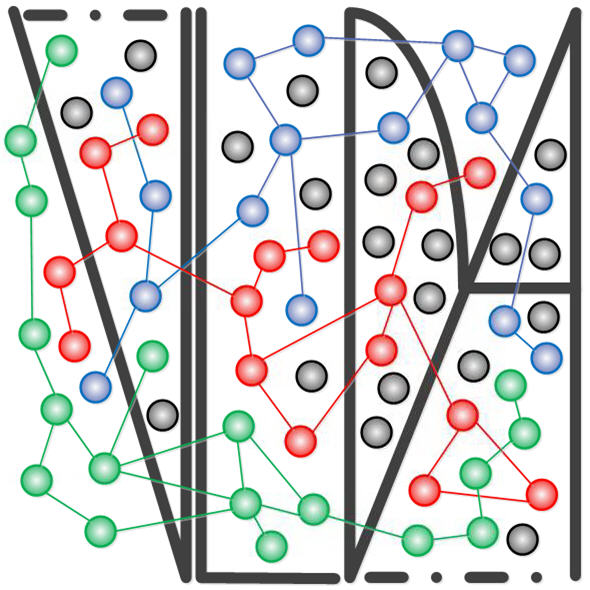
A Diagram Of Voluntary Law Societies In Process Of Dissolving States

The areas enclosed by heavy black lines represent territorially-based, traditional states. The black-and-white circles represent state citizens. The colored circles represent people who are members of voluntary law societies (VLSs); some are also state citizens. Each color represents a different VLS. Where a clear majority of citizens are VLS members, the state will begin an orderly dissolution – as represented by the dashed lines and partially enclosed areas.  In some places, the state does not exist at all and everybody belongs to a VLS of one type or another.  The diagram illustrates how VLSs can co-exist with traditional territorially-based states, as well as displace them.

The state boundaries form the letters VLDA – just in case you failed to notice.

Voluntary Law

Diagram of Vountary Law Societies In Process of Dissolving States

Image